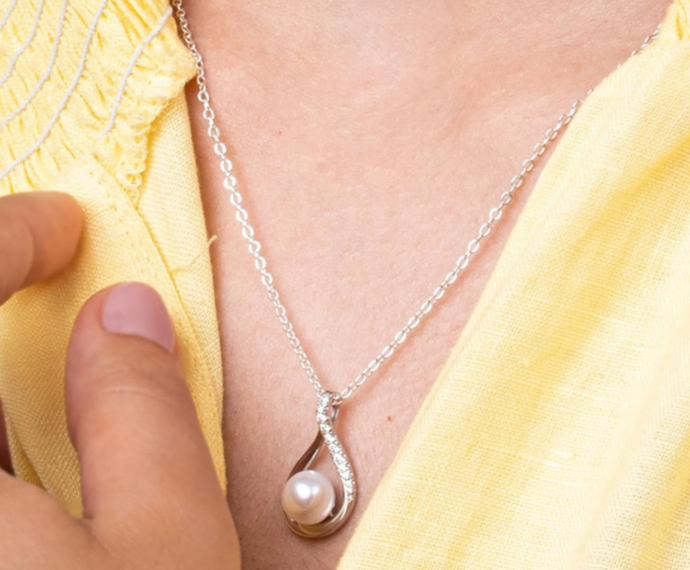
Putting a pendant with a chain should be natural. Once you have found your ideal match, the pendant is an integral part of the style you make, comfortably on your chest, bringing everything else you are wearing together into one cohesive look. The problem is that for many people who love jewellery, the pendant and chain are separate items, selected based on appearance in a showcase without thought for how they fit with the particular chain.
How to Choose a Pendant?
The process of choosing an appropriate piece of jewellery for yourself requires close analysis of the physical properties of both the pendant itself and the chain that will hold it. Just sticking something pretty on any old metal string doesn’t give you an acceptable piece of jewellery at all. It is necessary to analyse the harmony between the two parts in terms of weight, size, shape, and other characteristics to achieve a well-balanced piece of jewellery.
Weight
When talking about the structural stability of stylish silver pendants, physical weight is the most crucial factor. In general, the weight of the hanging piece should not exceed that of the chain holding it. For example, when a heavy metal medallion is on a thin, fragile cable link, after some time under constant friction and tension, the chain will inevitably break.
Size
The size of your work will determine the visual effect and the type of bail used. Bail refers to the metal loop attached to the top of the pendant from where the necklace passes through. It is important that you take into account the largest point of the clasp and that it will actually fit through the bail. Otherwise, if you use a small loop, you won’t be able to wear it on your necklace.
Shape
Depending on the shape of the hanging component, the way the jewellery interacts with the wearer’s body, and the amount of light reflected from its surface, changes. Jewellery pieces made using geometric shapes with sharp corners, like rectangles, squares, and cross-like figures, maintain their positions better compared to their rounded counterparts; however, they can get entangled in the threads of any dress you wear. Smooth rolling round shapes, such as circles, ovals, or even a teardrop shape, will flow smoothly along the metal links.
Tips
Knowing how weight, size, and shapes function together structurally, it could provide useful advice on stylish techniques for improving your style. With the following hints at hand, you will learn how to polish your jewellery, making it absolutely impeccable in terms of design and appearance, no matter how active your life may be.
Proportion
As for proportions, it all comes down to maintaining the right balance between the thickness of the metal strands and the size of the decorative element. As an effective guideline to work with, the one-to-three proportion can be recommended, which means that the width of the hanging ornament should be at least three times wider than that of the metal wire used. Thus, the decorative element will be emphasised as the focal point of the necklace, and the metal strand will not be rendered invisible.
Flipping
One of the most aggravating challenges faced by jewellery enthusiasts is a pendant that continually rotates or flips over, thus turning its face away from the viewer to expose a flat metallic surface at the back. This aggravating problem is mostly due to an error in the centre of gravity when designing the jewellery’s bail. Heavy charms and thin bails are very likely to flip over at any time when the head tilts forward.
Pendant Care
For your jewellery combination to look as brilliant as when you first acquired it, you must develop a maintenance habit that includes regular cleaning and inspection of the items. With daily activities, there will always be traces of body oil, lotion from the skin, perfume, and even dust on your bail and behind your gems that may reduce the shine of your metal components. After every day’s wear, wipe down the jewellery combinations using a soft microfiber towel before storing them.
At least once per month, inspect the state of your jewellery combinations with regard to the quality of the metal used, the condition of the prongs, and whether there are any cracks around where the loop meets the rest of the charm. If you notice any weakness, stop wearing the piece immediately and take it to a professional jeweller for repair, ensuring you never risk losing a precious heirloom due to а failure.
Learning the perfect proportion between a sterling silver pendant for sale and a chain is what allows the maximum out of wearing jewellery. The weight limitations, sizes, and shapes are physically the key to creating an attractive ornament that can be worn comfortably, safely, and elegantly. By using styling tips, one can ensure silver pendants always face forward when in motion.