While the material handling sector is seeing a steady rise in automation and electrification, basic manual trolleys remain an irreplaceable component of global supply chains. In demanding environments like hospitality, food processing, warehousing, and manufacturing, operations prioritise high load capacities, corrosion resistance, and long-term durability. Where hygiene and workplace safety can make or break a business, stainless steel trolleys serve as the ultimate workhorse. moving goods and equipment safely, quickly, and efficiently.
Why Choose Stainless Steel?
With strict operational requirements regarding workplace health and safety, many Australian businesses prioritise the improved performance and durability of stainless steel trolleys. Compared to common alternatives, including reinforced plastics and aluminium, stainless steel variants provide multiple benefits:
- Superior hygiene and sterilisation: The non-porous stainless steel surface is resistant to bacteria, viruses and mould and withstands harsh cleaning agents and disinfectants.
- Corrosion and chemical resistance: High-grade 304 and 316 stainless steel resists rust, moisture, acids and alkaline agents better than regular galvanised mild steel or aluminium.
- High-load capacities: Trolleys with reinforced frames can easily handle extreme loads without bending, warping or tipping. Load capacities range from 100 kilograms in smaller, light-duty trolleys to over 800 kilograms in heavy-duty, industrial variants.
- Reduced maintenance: Resistance to temperature extremes, moisture and contaminants means trolleys require little to no maintenance apart from regular cleaning. Unlike mild steel or aluminium, they also forego the need for protective coatings.
- Aesthetic appeal: Polished metallic surfaces and clean welds provide clean, functional aesthetics in sectors such as hospitality, kitchens and health facilities.
Common Stainless Steel Trolley Types and Configurations
To meet diverse needs in multiple industries and applications, stainless steel trolleys come in several types and configurations. Common options include:
- Platform trolleys: Built around a large, low-set flat platform, these are designed to carry heavy, oversized items and equipment in manufacturing facilities, warehouses, cold rooms and other settings. They benefit from textured non-slip platform surfaces to ensure stability and safety, tubular waist-height handles for easy movement and industrial-grade castors for mobility and high load capacities.
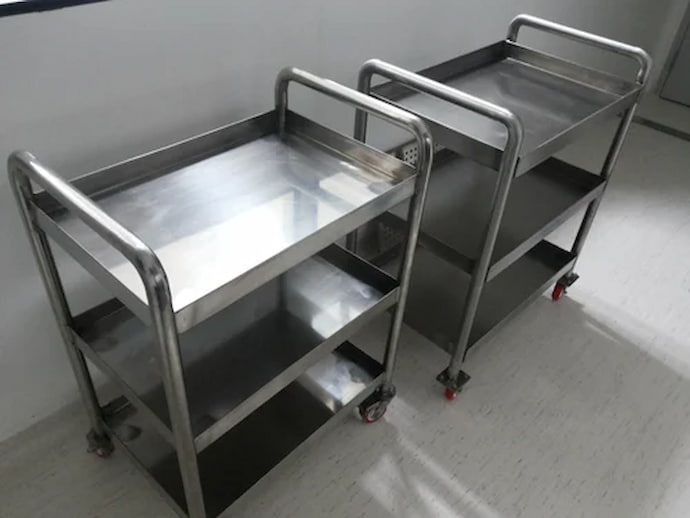
- Tiered and shelving trolleys: Featuring a sturdy, tubular frame and a customisable number of height-adjustable individual shelves, these are lightweight yet robust options commonly seen in hotels, airports, restaurants, commercial kitchens and workshops. Their versatility can be increased with the inclusion of additions such as cages, baskets and drawers, complementing shelves with raised side walls and soft-tread swivelling castors.
- Bin trolleys: Commonly seen in offices, libraries, mail rooms, laboratories and food processing plants, bin trolleys get their name from one or multiple bins or crates in industry-standard or customisable sizes, sitting atop shelving or inserts suspended from a tubular frame. Most are equipped with four swivelling wheels for easy manoeuvring in confined workplaces, often with integrated rear brakes.
- Specialty trolleys: This includes linen trolleys with multiple shelves, vertical guard bars and rubber buffers at each corner sitting on a tubular, stainless steel frame, used in linen rooms, hotels and hospitals; medical and instrument trolleys equipped with single, half-extension drawers -seen in clinics, hospitals and aged care facilities; and round or square bone or waste bin dollies used in meat processing, abattoirs and wet industrial settings.
Configuring Your Stainless Steel Trolley
Sourcing the right stainless steel trolley means meeting industry-specific demands relating to load capacities, material grades, and compliance with safety guidelines.
Stainless Steel Grades and Settings
Grade 304 stainless steel is the standard benchmark in Australia for dry warehousing and hospitality due to its exceptional structural strength and rust resistance. However, applications involving coastal air, medical sterilisation, or aggressive chemical cleaning require an upgrade to Grade 316 marine-grade stainless steel to avoid premature corrosion and pitting.
Load Capacities and Configurations
Choose a trolley with a load rating suitable for the intended use. As an illustration, larger, heavy-duty platform trolleys can handle loads of up to 800 kilograms, rivalling standard pallet jacks and hand trucks in tightly-knitted spaces. Tiered trolleys vary in capacity, with most shelves comfortably handling 25 kilograms each. The wide selection of customisable heights and shelf count means multiple options in material handling equipment that clearly align with load types to provide efficient transportation and seamless workflow.
WHS Compliance and Ergonomics
To eliminate or minimise workplace injuries and risks, trolleys must meet strict industry rules and guidelines. These relate to trolley designs, with 900mm to 1000mm handle heights for easy pushing or pulling; welded or flat-pack designs to ensure rigidity and stability during operation and trolleys with defined Safe Working Loads (SWLs) to accommodate the heaviest anticipated loads, plus a safety margin.
Mobility with the Right Casters
Mobility, safety and overall durability largely depend on properly chosen casters. Choose nylon casters for high load-bearing capacities, low rolling resistance and resistance to chemicals and corrosion in commercial kitchens, hotels, food processing plants, cleanrooms, warehouses and healthcare facilities. Polyurethane casters are preferred on softer flooring, helping cushion heavy loads and providing quiet and smooth rolling.
Their high chemical resistance makes them common features on stainless steel trolleys in the pharmaceutical and food processing industries, as well as laboratories and hospitals. For applications requiring superior strength, choose stainless steel castors. These not only handle heavier loads, but also withstand harsh conditions with high heat and moisture. Lastly, for simplified movement across varied surfaces, configure trolleys with swivelling or fixed casters, locking brakes and sealed bearings.